
When the Landscape Is the Architecture, the Lighting Should Follow Suit
How thoughtful lighting protects a landscape architects design long after sunset
You spend months shaping a site—grading, planting, circulation, views—only to watch the whole composition disappear the moment the sun checks out.
The architecture still holds. The hardscape still holds. But the landscape you authored? That needs a lighting partner who can actually read a plan. Because on a large-scale project, the landscape is the architecture. And at night, the wrong lighting makes the design feel like someone edited the story after you wrote it.
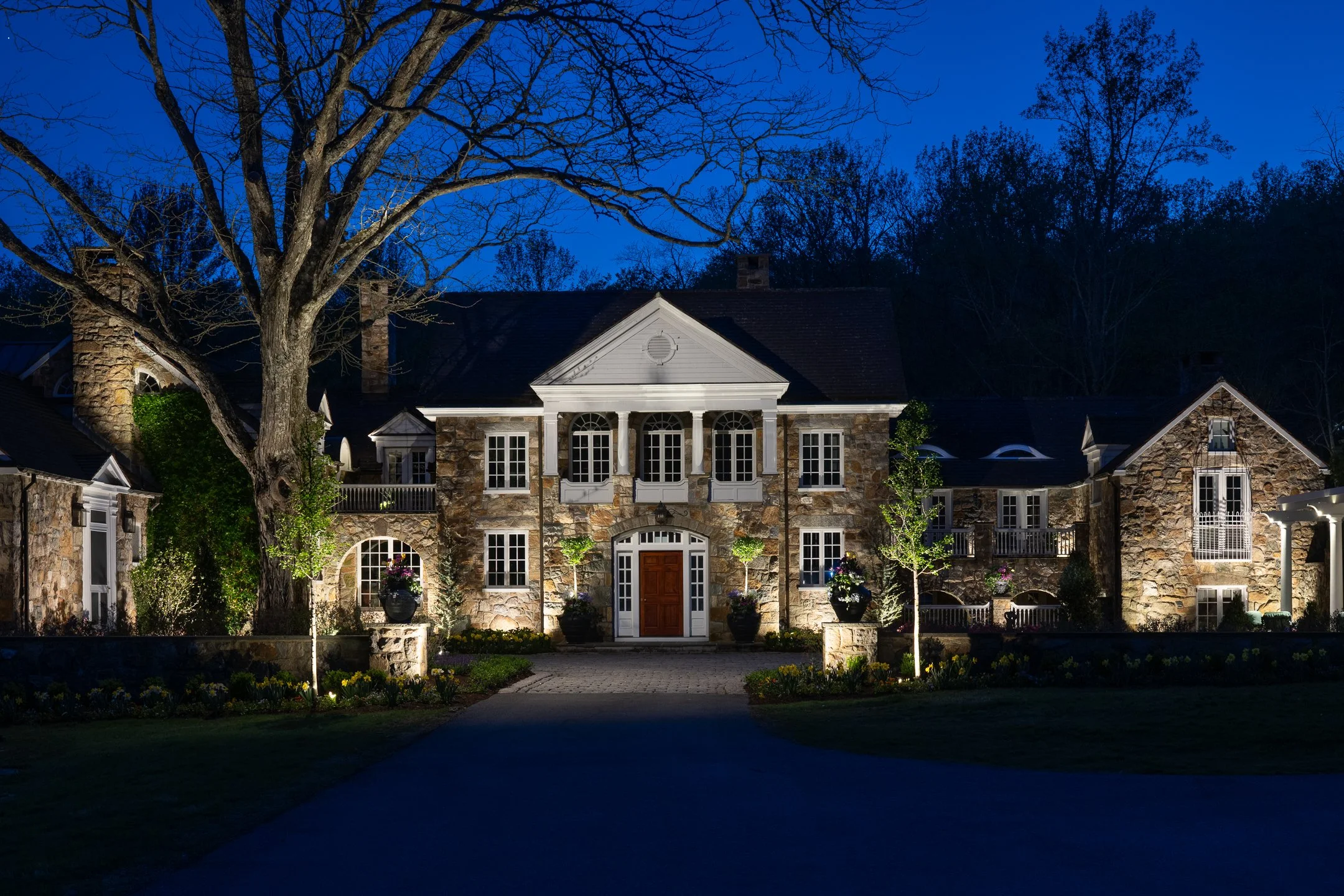
Photo: A wide nighttime view showcasing balanced, design-first lighting across the entire estate façade. Architectural uplighting defines the stone texture and symmetry, while carefully scaled tree lighting anchors the composition in the foreground. The scene feels intentional and calm, preserving the home’s hierarchy and presence while keeping the landscape legible after dark.
When the Landscape Becomes the Structure
On luxury properties, planting design does the same work as built form: it frames arrival, guides movement, and shapes the experience from every viewpoint. By the time your drawing set reaches the contractor’s table, the mood, hierarchy, and intent are already established.
Lighting should follow that intent—not improvise its own agenda.
The goal isn’t to “highlight features.” It’s to preserve scale, clarity, and visual rhythm. Thoughtful lighting ensures the estate behaves the way you designed it at 10 p.m., not just at 10 a.m. And when you take a design-first approach to custom landscape lighting, every planting bed, elevation, and sightline holds its shape after dark.
If you’d like a closer look at how we approach this, here’s our process for custom landscape lighting.
Where Most Lighting Contractors Miss the Intent
You’ve seen it happen before:
Value engineering that fractures carefully built hierarchy
Random fixtures that ignore your planting plan
Hot spots, glare, or path lights that behave like runway markers
“We’ll figure it out on site,” which never reads as confidence
Lighting introduced too late, forcing compromises everywhere else
On luxury properties, these aren’t small missteps. They’re breaks in continuity—tiny fractures that make the design feel less cohesive, less intentional. And once the client sees it, it lands back on everyone, even when the problem wasn’t yours.
A Lighting Partner Who Sees the Plan the Way You Do
Landscape architects often tell us they want three things—rarely stated outright, but always felt:
Respect for proportion
Understanding of negative space
A sense of when not to light
Lighting shouldn’t compete with your work. It should reveal it. That’s why we start with your plans:
Grades. Plant palettes. Key sightlines. Architectural gestures
The lighting scheme comes from those decisions—not from a catalog
Your focal points stay focal. Your transitions stay transitions. Your planting stays legible instead of washed out. And the nighttime version feels as considered as your drawing set.
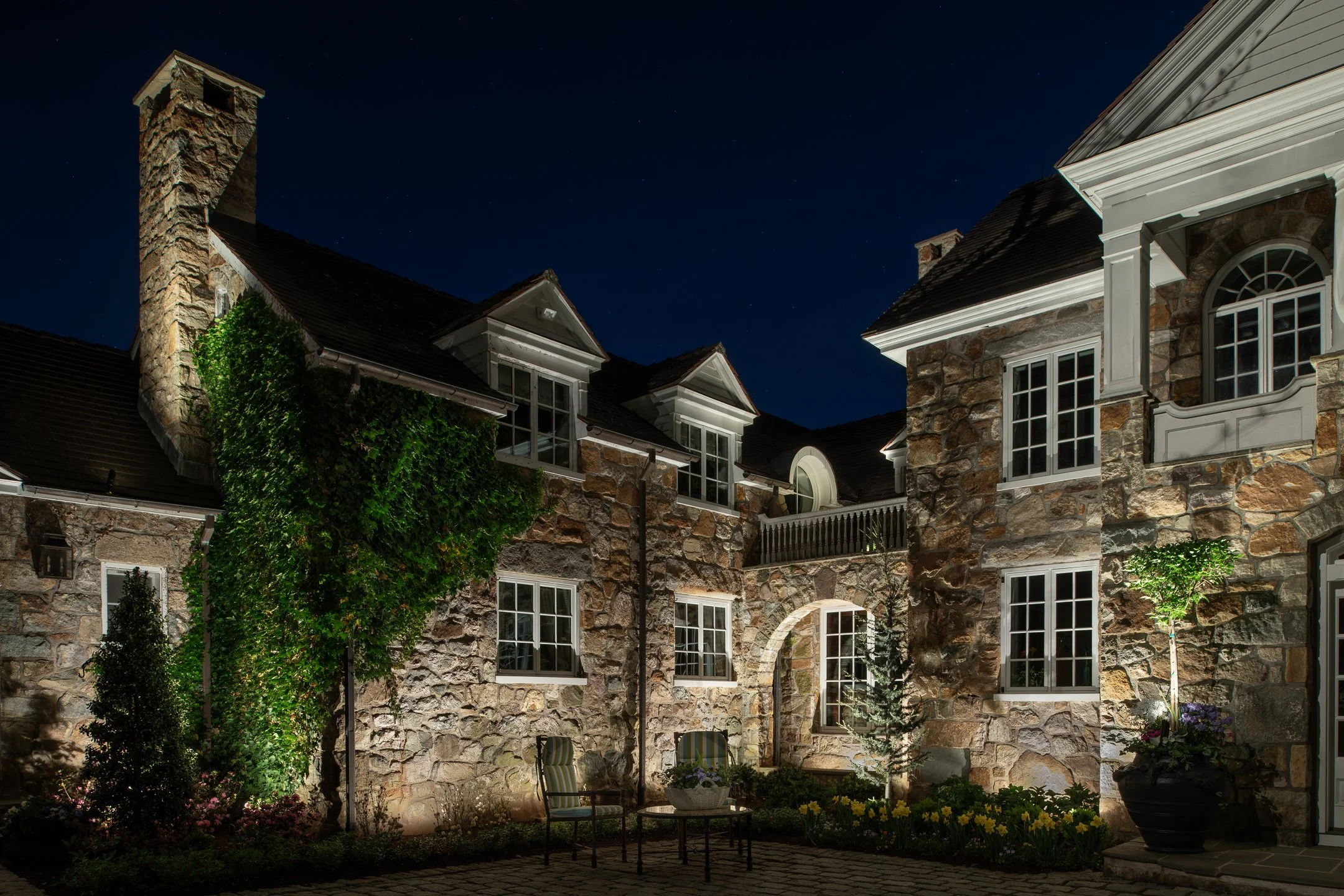
Photo: Warm, low-positioned uplighting reveals the texture of the stone façade, the massing of the climbing vines, and the quiet rhythm of the windows and archway. The lighting creates a composed nighttime scene—balanced, intentional, and scaled to the architecture—without overpowering the planting or washing out detail.
Clean Coordination Makes Everyone Look Good
Estate projects don’t unfold in straight lines. They’re choreography—site contractors, GCs, pool builders, masons, electricians, and your own team all moving in sequence.
Our work fits into that rhythm:
Clear markups, fixture schedules, and conduit notes
Coordination with site contractors and electricians
Clean trenching, protected root zones, and invisible cable routes
Install days that don’t feel like a job-site takeover
Predictable timelines that don’t create surprises
If you’re curious how we approach installation on complex sites, here’s our philosophy on outdoor lighting installation.
Your Work, Still Beautiful at 10 p.m.
Estate clients rarely articulate what they want at night. They tell you how they want it to feel:
Warm — a landscape that carries its daytime calm into the evening
Composed — sightlines, forms, and plantings that still hold their shape
Intentional — nothing blown out, nothing guessed, nothing improvisational
Luxury landscape lighting isn’t decorative—it’s architectural. It:
Preserves form and mood
Maintains the hierarchy you established
Lets the landscape behave as you designed it: quietly, confidently, intelligently
This is why nighttime matters. It’s the version your clients live with just as much as the daytime one.
What a NatureScape Lighting Installation Includes
“Collaborative planning, fixture selection based on architecture and planting, low-voltage system design, concealed wiring routes with hardscape and planting in mind, and precise aiming and beam spread to ensure balance and glare control.
It also includes transformer placement, safe voltage distribution, and post-install adjustments. The goal is a lighting system that supports, rather than alters, the original design intent.”
Post-Install Care That Protects Your Reputation Too
Landscapes evolve. Trees fill out. Beds expand. Clients add elements over time—and lighting has to evolve with them:
Aiming adjustments as plant mass changes
Scene rebalancing to preserve hierarchy and mood
Component updates as technology and site needs shift
Ongoing check-ins to keep the system performing the way it should
Our Continuing Care Program keeps the estate looking like the project you signed—not the project from installation day. It ensures the lighting keeps pace with the site, not the other way around. Your work stays intact. Your client stays happy—your phone stays quiet. See how our team supports your clients with our Continuing Care Program.
What It’s Like When NatureScape Is on the Site Team
-
With lighting that follows your lead and execution that protects your reputation.
-
Predictable, design-literate, and low-drama.
-
Because the property deserves continuity from day to night.
Let’s Talk Outdoor Lighting
If you’d like to talk through an upcoming project—or just compare notes on how lighting fits into your design work—we’d be happy to start the conversation. A call, a meeting, whatever works for you.
Lighting New Jersey


NatureScape Lifestyle

Meet The Designers


FAQs for Landscape Architects
-
Earlier than most people think—usually during planting layout or grading. This avoids trenching conflicts, protects root zones, and preserves long-term sightlines.
-
Absolutely. Clean, legible, design-literate markups based on your plans—nothing cluttered, and nothing that competes with your graphics.
-
Root-sensitive routing, clean trenching, invisible cable paths, and crews who understand they’re working inside a finished landscape, not starting one.
If you’ve enjoyed reading this, please share
with a friend and follow us on social.

For Landscape designers, early collaboration ensures landscapes look intentional by day and unforgettable at night.